
What do India’s Four Labour Codes mean for mine workers? Workers in the mining sector have provisions for safer workplaces, free annual health examinations where prescribed, regulated working hours and employment-linked protection for qualifying commuting accidents. This guide explains the key safeguards, their legal conditions and what mine employers and employees should check.
Standard maximum working week for mine workers
The reforms also address notified occupational safety standards, medical examinations and employment-related accident protection. Overtime and scheduling must follow applicable rules.
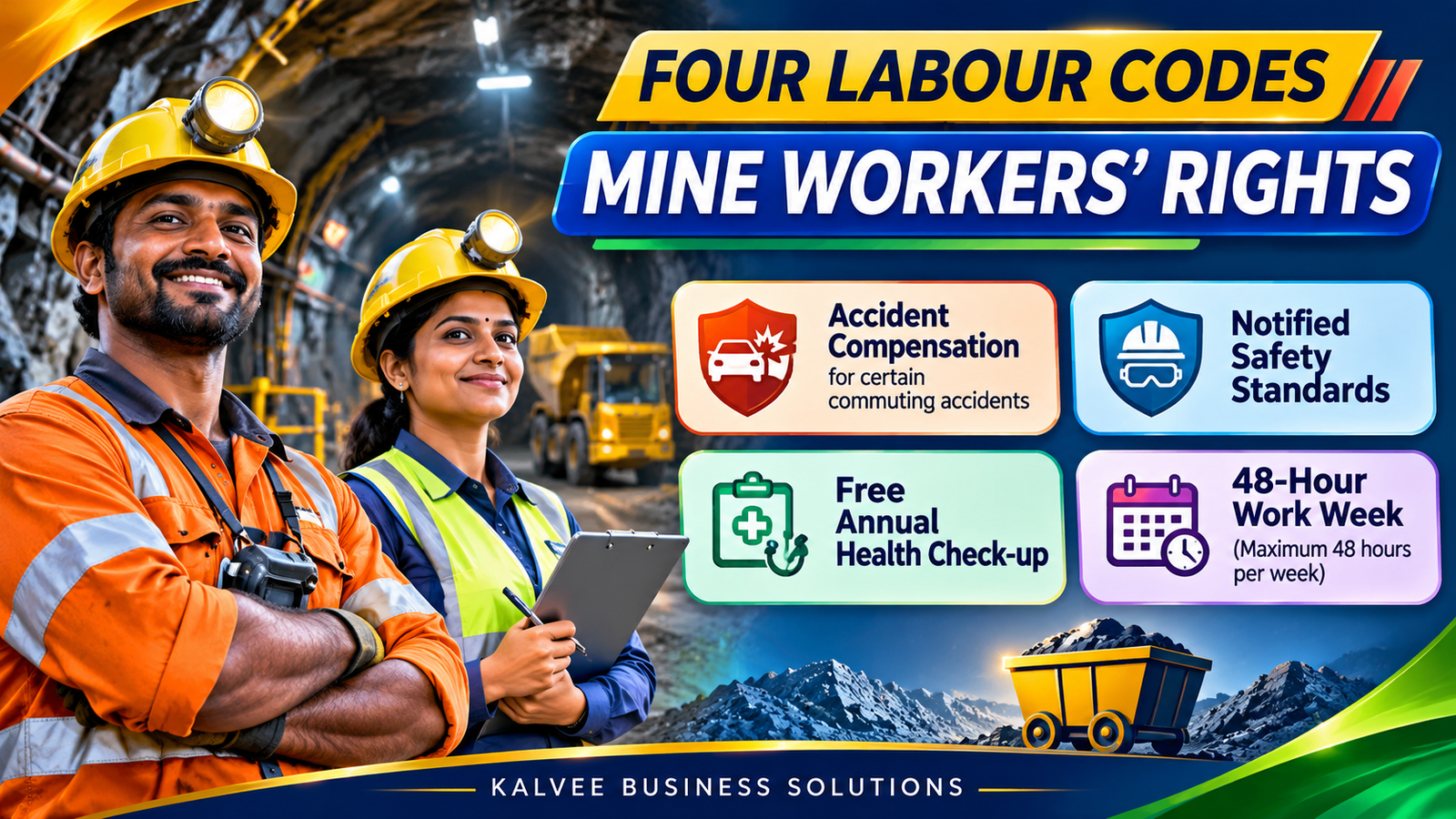
Key takeaways at a glance
- ✓Commuting accidents: May be treated as employment-related when the required connection to work, time, place and circumstances is established.
- ✓Safety standards: Employers must comply with applicable notified occupational safety and health standards.
- ✓Medical protection: The OSH&WC Code provides for free annual examinations or tests for prescribed classes of workers and establishments.
- ✓Working hours: The normal working week is capped at 48 hours; additional time is regulated, with overtime pay obligations.
What are India’s Four Labour Codes?
The Government of India brought the four Labour Codes into effect on 21 November 2025, consolidating 29 central labour laws. The Codes address wages, industrial relations, social security and occupational safety. For mine workers, the Code on Social Security, 2020 and the Occupational Safety, Health and Working Conditions (OSH&WC) Code, 2020 are particularly important. Read the government’s implementation announcement.
| Labour Code | Broad focus | Relevance for mine workers |
|---|---|---|
| Code on Wages, 2019 | Wage standards and timely payment | Minimum wage protection and relevant pay safeguards |
| Industrial Relations Code, 2020 | Industrial relations and disputes | Workplace relations and dispute processes |
| Code on Social Security, 2020 | Social insurance and employee benefits | Employment injury and eligible social-security benefits |
| OSH&WC Code, 2020 | Health, safety and working conditions | Safety standards, medical checks, work hours and welfare arrangements |
Four important benefits for mine workers
1. Employment-related commuting accidents
A qualifying accident travelling between home and work may fall within the course of employment if the legal connection between the journey and employment is established. Benefit or compensation eligibility is not automatic.
2. Notified safety standards
Mine operators must follow the occupational safety and health standards applicable to their operations, including relevant controls for dust, gases, ventilation, explosives, machinery and protective equipment.
3. Annual health examinations
The OSH&WC framework requires free health examinations or tests for employees in categories prescribed by the appropriate government. Mine-specific periodic and exposure-related medical requirements may also apply.
4. A regulated working week
The government identifies 48 hours as the ordinary weekly limit for mine workers. Daily scheduling, breaks, consent and overtime require attention to the Code and relevant rules.
When can a commuting accident qualify for compensation?
Section 34(3) of the Code on Social Security, 2020 provides that an accident during a journey between a worker’s home and place of employment, before or after duty, may be deemed work-related when a sufficient nexus between the circumstances, time, place and employment is established. The nature of the employment, insurance/compensation scheme and evidence determine the route to benefits.
Documents worth keeping after an accident
- Report the accident promptly to the employer or designated mine official and obtain an acknowledgment.
- Obtain medical records recording injuries, treatment dates and any relevant disability findings.
- Record the journey details — date, time, location, route, shift timings and purpose of travel.
- Preserve supporting evidence such as police reports, transport details, witness contacts and employer records where available.
- Check the correct claim channel — employer, applicable ESI authority or employee-compensation mechanism, as appropriate.
What notified occupational safety standards mean for mines
The OSH&WC Code obliges covered employers to maintain safe systems of work and comply with safety and health standards prescribed or notified under the law. In mining, practical safeguards include monitoring airborne hazards, safe machinery operation, protective equipment, accident prevention, emergency preparedness and worker training.
According to the government’s sector-specific backgrounder, safety committees are envisaged for mines ordinarily employing 100 or more workers, with worker and employer representation. Specific implementation requirements should be checked against the relevant mine regulations and the rules currently applicable.
Annual health checks: who is eligible?
Section 6(1)(c) of the OSH&WC Code directs employers to provide free annual health examinations or tests for workers, age groups and establishment classes prescribed by the appropriate government. Government communications highlight broader preventive healthcare for mine workers, including exposure-related medical surveillance.
Mine workers’ working hours and overtime
| Protection | Government explanation | Practical point |
|---|---|---|
| Ordinary working hours | 8 hours per day, with ordinary weekly hours capped at 48 | Check shift records and applicable legal exceptions |
| Rest intervals | Generally, a minimum 30-minute rest after no more than five hours of continuous work | Shifts should provide required breaks |
| Overtime | Payable at twice the normal rate when applicable | Obtain required consent and follow authorised overtime limits |
| Weekly rest | Working schedules allow for weekly days off under the applicable framework | Maintain proper rosters and records |
Some legally permitted work patterns involve different daily spreads of hours; those arrangements should not be treated as permission to ignore rest, consent, overtime or other applicable requirements. Confirm the correct current rules for underground or opencast operations.
Compliance checklist for mining employers
- Issue appointment letters and maintain accurate employee details.
- Document hazard assessments and comply with applicable safety standards.
- Provide prescribed protective equipment and safety training.
- Arrange applicable medical checks at no cost to covered workers.
- Maintain duty rosters, rest periods and overtime payment records.
- Establish safety committees wherever legally required.
- Maintain incident reports and clear employee-compensation procedures.
- Check updated Central/State rules and sector-specific mine regulations.
Frequently asked questions
Are all accidents while travelling to a mine covered?
No. Section 34(3) requires a nexus between the circumstances, time and place of the accident and the employee’s work. Eligibility and compensation also depend on the relevant social-security or compensation scheme.
Is the maximum work week 48 hours?
Yes, the government’s mine-worker explanation identifies 48 hours as the ordinary weekly limit. Overtime, permitted work patterns, rest intervals and any applicable exceptions must be considered separately.
Is overtime payable at double wages?
The government explains that qualifying overtime is payable at twice the normal wage rate. The worker’s consent and applicable overtime limits and rules must also be followed.
Does every mine worker receive a free annual medical examination?
The government highlights free annual health examinations. The operative legal duty applies to the employee and establishment categories prescribed by the appropriate government, together with any additional mine-related medical requirements.
When did the Four Labour Codes become effective?
The Central Government announced that the four Labour Codes took effect on 21 November 2025. Detailed compliance depends on applicable rules and notifications.
Where can I read the official rules?
Read the Chief Labour Commissioner (Central) website, Ministry of Labour and Employment, and the government sources listed below.
Know your rights. Strengthen mine safety.
Whether you manage a mining establishment or work at one, review the applicable rules, document safety procedures and refer to official government guidance before making an employment or compliance decision.
Official references and further reading
- Press Information Bureau: New Labour Codes to Empower India’s Mine Workers (6 December 2025)
- PIB: Four Labour Codes brought into effect (21 November 2025)
- India Code: OSH&WC Code, 2020
- Ministry of Labour and Employment: Labour Codes and FAQs
- Chief Labour Commissioner (Central): Official website
Editorial note: Information reviewed on 10 November 2026. This is an independent educational article by Kalvee Business Solutions; it is not a government notification or individual legal advice. Statutory entitlements vary with coverage, conditions and the applicable Central or State rules. Verify updates on official portals before taking action.
From compliance guidance to action
Use the free tool for a first calculation, request case-specific support, or explore useful templates.
Calculate salary, PF & ESIC
Estimate payroll deductions and employer costs with a free calculator.
Open free toolRequest a compliance health check
Tell us about your business to request a free 15-minute compliance check. No automatic legal assessment is promised.
Request a free checkMSME Business Toolkit
Current listed price ₹199. Five ready-to-use tools for everyday MSME administration.
Explore the toolkitFree calculators provide estimates, not individual legal or financial advice. Product purchases are completed on KalveeMart.